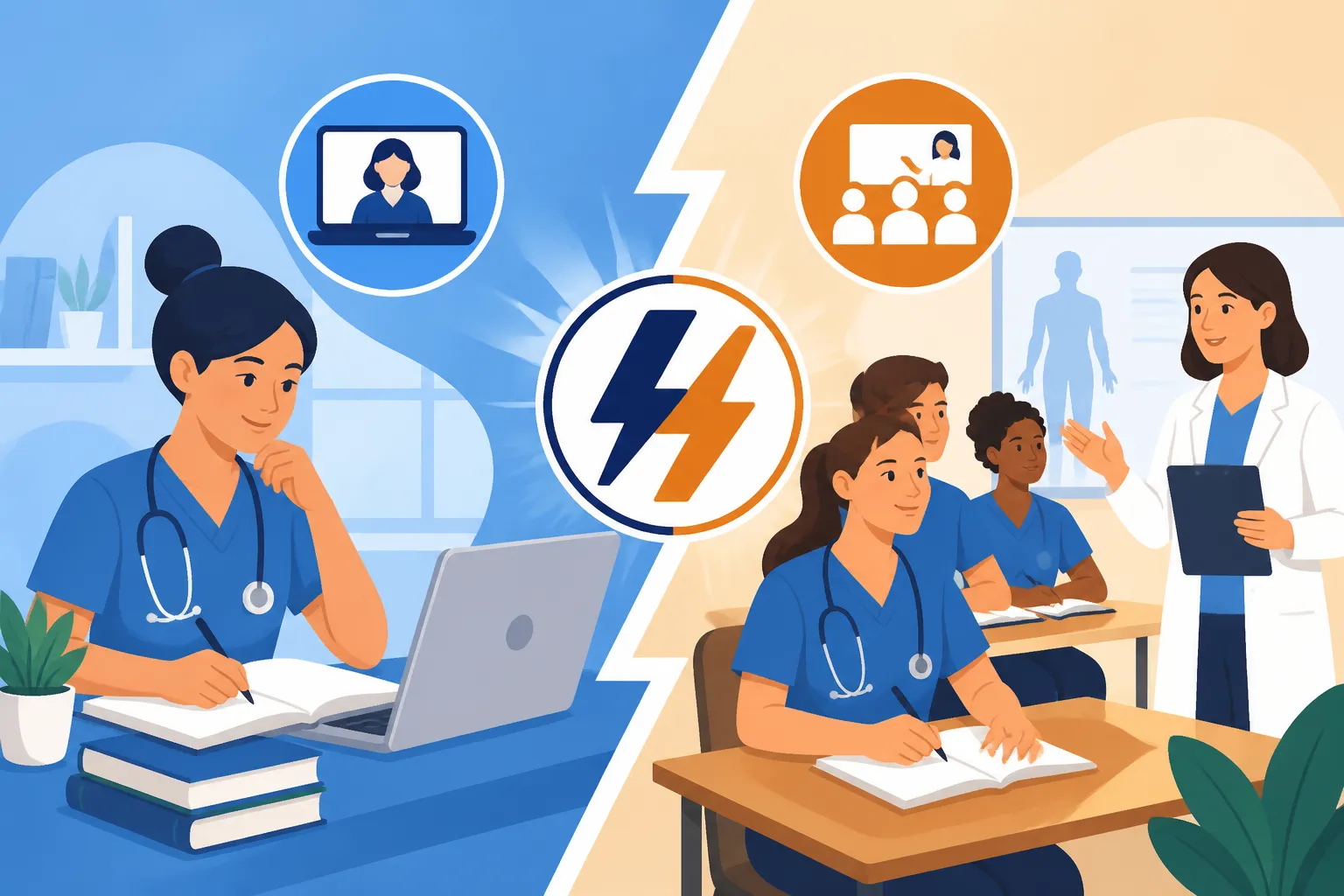
RN to BSN Online vs In-Person
Deciding to go back to school for your Bachelor of Science in Nursing (BSN) when you're already a registered nurse (RN) is a huge step, and one of the first big questions that usually pops up is: "Should I do it online or in-person?" It’s a completely valid concern because both options have their unique benefits and drawbacks, and what works wonderfully for one nurse might be completely impractical for another. This guide will walk you through the nuances of both online and in-person RN to BSN programs, helping you weigh your options against your personal life, learning style, and career aspirations.
Understanding the RN to BSN Degree
For many nurses, the journey to becoming an RN began with an Associate Degree in Nursing (ADN) or a nursing diploma. These programs provided the essential clinical skills and foundational knowledge to pass the NCLEX-RN and step onto the hospital floor. But the healthcare landscape is constantly evolving, and the push for higher education in nursing has become increasingly prominent.
Why Pursue a BSN as an Already-Licensed RN?
You've got your license, you're working, you're making a difference every single day – so why go back for more schooling? This is a question many seasoned RNs grapple with, especially when their plates are already full. The truth is, while your ADN or diploma made you a competent clinician, a BSN equips you with a broader, more holistic understanding of nursing practice. It delves deeper into areas like community health, leadership, evidence-based practice, and nursing research.
Hospitals, particularly those striving for or maintaining Magnet Recognition Program® status, increasingly prefer or even require their nurses to hold a BSN. This isn't just about prestige; it's rooted in research showing that a more educated nursing workforce correlates with improved patient outcomes, reduced mortality rates, and fewer medical errors. So, pursuing a BSN isn't just about personal growth; it's about staying competitive in the job market and being prepared for the complexities of modern healthcare. If you're wondering if it's truly worth the effort, our detailed guide on Is an RN to BSN Worth It delves into the return on investment.
Core Curriculum of an RN to BSN Program
Regardless of whether you choose an online or in-person format, the core curriculum for an RN to BSN program is designed to build upon your existing nursing knowledge and expand your scope of practice. You've already mastered the hands-on skills and patient care fundamentals. Now, it's about developing critical thinking, leadership capabilities, and a deeper understanding of public health.
Typical courses often include advanced health assessment, nursing research and evidence-based practice, leadership and management in nursing, community health nursing, healthcare policy, and professional nursing concepts. While you won't be repeating your foundational ADN coursework, you'll engage with these subjects at a baccalaureate level, requiring more analytical thought and application of theory. This shift can sometimes feel like a steep climb, even for experienced nurses, as it requires a different kind of academic engagement than what you might be used to from your initial RN training. Understanding the full scope of RN to BSN Curriculum Overview can help you prepare mentally.
The Online RN to BSN Experience
Online learning has truly revolutionized access to higher education, especially for working professionals like nurses. For many, the idea of fitting traditional classes into an already demanding work schedule feels impossible. That's where online RN to BSN programs shine, offering a flexible pathway to career advancement.
Flexibility and Self-Paced Learning
The most celebrated aspect of online RN to BSN programs is undeniably their flexibility. Imagine finishing a demanding 12-hour shift, coming home, unwinding, and then tackling your coursework on your schedule. No commuting to campus, no strict lecture times you have to attend in person. You can log in after the kids are asleep, during your days off, or even squeeze in some reading during a quiet moment at work (if your facility allows and it doesn't interfere with patient care, of course!).
This freedom allows you to tailor your study habits to your life. For nurses juggling full-time work, family responsibilities, and maybe even a social life, this adaptability is a game-changer. Many programs are designed to be largely asynchronous, meaning you access materials and submit assignments within a given timeframe, rather than participating in real-time online lectures. This allows for truly self-paced learning, letting you move faster through familiar topics or take more time with challenging ones. If you're a working nurse, our guide on RN to BSN for Working Nurses offers practical strategies.
Online Course Structure and Engagement
When people think of online learning, they sometimes picture a solitary experience, just you and a computer. While there's certainly an independent component, modern online RN to BSN programs are far from isolating. Most utilize robust learning management systems (LMS) like Canvas, Blackboard, or Moodle, which serve as virtual classrooms. Here, you'll find modules with readings, video lectures, discussion boards, assignments, and quizzes.
Interaction with peers and instructors is built in through discussion forums, where you'll respond to prompts, engage in debates, and share your clinical experiences. Group projects are also common, fostering collaboration in a virtual environment. While it's not face-to-face, the discussions can be incredibly rich, drawing on diverse perspectives from nurses across various specialties and geographical locations. For some, the anonymity of an online forum even makes it easier to speak up and ask questions without the fear of judgment. You'll still need to be self-motivated and disciplined, as the structure, while flexible, requires you to stay on track without a physical classroom to attend. Resources like Uworld, for instance, can be helpful complements to your primary coursework, offering additional practice questions or review materials if you feel certain concepts need extra reinforcement.
Clinical Experiences in Online Programs
One of the biggest misconceptions about online RN to BSN programs is the idea of "no clinicals." As a licensed RN, you've already completed extensive clinical hours to earn your initial license and are actively practicing. Therefore, traditional hospital-based, hands-on clinical rotations are generally not a component of the RN to BSN curriculum. This is a huge relief for many nurses who simply can't spare the time for more bedside shifts.
Instead, the "clinical" component in an online RN to BSN typically involves what's called a community health or leadership practicum. These are usually project-based experiences that you complete in your local community or even at your workplace, under the guidance of a preceptor. This might involve developing health education materials for a local clinic, participating in a public health initiative, or completing a leadership project within your hospital unit. You're applying BSN-level concepts to real-world scenarios, often in a non-traditional clinical setting. It's a fantastic way to expand your understanding beyond the hospital walls. Our guide on RN to BSN Clinical Hours Explained offers more specific details.
The Traditional In-Person RN to BSN Experience
While online options have grown exponentially, the traditional in-person RN to BSN path still holds significant appeal for many, offering a different kind of structure and engagement that some learners thrive on.
Structured Learning and Campus Life
For those who prefer a more structured academic environment, an in-person RN to BSN program might be the perfect fit. You'll have set class times, physical lectures, and dedicated lab sessions (though for RNs, these labs are often more simulation-based than hands-on skill practice, focusing on advanced scenarios). This routine can be incredibly beneficial if you struggle with self-discipline or find it hard to carve out study time independently. The fixed schedule essentially forces you to be present and engaged.
Beyond the classroom, choosing an on-campus program opens up the entire university experience. You'll have direct access to campus resources like libraries, tutoring centers, student health services, and career counseling in person. For some, the atmosphere of a college campus is motivating, fostering a sense of academic community. While you might not be a typical freshman, participating in nursing student associations or campus events can provide a refreshing break from the daily grind of nursing.
Direct Interaction and Networking
One of the standout advantages of an in-person program is the immediate, face-to-face interaction it provides. You can raise your hand and ask a question in real-time, get immediate clarification from your professor, and engage in spontaneous discussions with classmates during breaks. This direct engagement can be invaluable for clarifying complex topics and building rapport with instructors.
Beyond the classroom, in-person programs offer unparalleled networking opportunities. You'll build strong relationships with your professors, who are often experienced nurses and leaders in their fields. These connections can lead to mentorship, job opportunities, or references down the line. Similarly, your classmates become a vital support network. You might form study groups, share insights from your different clinical backgrounds, and forge lasting professional friendships. This direct human connection is something that, while mimicked in online forums, is often considered more robust in a physical setting.
Clinical Requirements for Campus-Based Programs
Just like their online counterparts, traditional in-person RN to BSN programs for licensed RNs typically do not involve repeating basic bedside clinical rotations. You've already done that! The focus shifts to community health, public health, leadership, and specialty experiences.
For an on-campus program, these "clinicals" might take the form of structured rotations in community settings, such as public health departments, schools, home health agencies, or specific hospital units focused on leadership or education. You might participate in health screenings at local events, spend time shadowing a nurse manager, or work on a quality improvement project within a healthcare system. While the scheduling for these can still be demanding, the university often has established partnerships with local facilities, making placement relatively straightforward. These experiences are designed to broaden your perspective beyond acute care and apply BSN-level theoretical knowledge to diverse healthcare environments.
Key Differences: A Side-by-Side Look
When comparing online versus in-person RN to BSN programs, it's not just about where you physically sit. It's about fundamental differences in structure, pace, support, and even cost that can significantly impact your educational journey.
Academic Rigor and Expectations
Let's dispel a common myth right away: neither online nor in-person RN to BSN programs are inherently "easier" or "harder" than the other. The academic rigor and expectations for a BSN-level education are the same, regardless of delivery method. You'll be engaging with advanced nursing theory, critical thinking, research, and leadership principles. What does differ is how that rigor is experienced.
In an online program, the burden of self-motivation and time management falls squarely on your shoulders. You're responsible for setting your study schedule, staying on top of deadlines, and proactively reaching out for help. This requires a high level of independence and discipline. In an in-person program, the structure of fixed class times and physical presence can provide external motivation, but it also means adhering to someone else's schedule. Some learners thrive with direct, real-time classroom discussions and immediate feedback, while others prefer the reflective nature of online forum interactions. Both paths demand dedication and a genuine commitment to learning.
Time Management and Personal Discipline
This is perhaps the most significant differentiator. An online RN to BSN offers unparalleled flexibility, allowing you to fit coursework around your busy life as an RN. You can study when you're most alert, whether that's late at night or early in the morning. However, this flexibility can be a double-edged sword. Without external deadlines for showing up to a physical class, it's easy for procrastination to creep in. You need strong personal discipline to stay on track and avoid falling behind, especially when life throws unexpected challenges your way. Our article on How to Balance Work and RN to BSN offers vital tips for this.
Conversely, an in-person program provides built-in structure. You have set class times, and missing a lecture means missing content and potentially falling behind. This can be a boon for those who need that external push. However, this structure also means less flexibility. You'll need to commute to campus, account for travel time, and potentially rearrange work shifts or family commitments to attend classes. This can be a major hurdle for nurses working unpredictable hours or those with significant family obligations. It's about weighing which form of "discipline"—internal or external—best suits your lifestyle.
Financial Considerations and Hidden Costs
The cost of an RN to BSN can vary wildly, and the online versus in-person debate has significant financial implications. Often, online programs can appear cheaper at first glance. They frequently eliminate commuting costs, parking fees, and sometimes even campus fees. Many online programs, particularly those offered by large, established universities like Western Governors University (WGU) or Capella University, are designed with affordability and scalability in mind.
However, "hidden" costs can emerge. Online learners might need to invest in reliable internet, a suitable computer, and potentially specific software. Textbooks and course materials are universal, but access to library resources might differ. In-person programs, while often having higher tuition and mandatory fees, might also provide better access to scholarships, grants, and on-campus job opportunities that can offset some expenses. Don't forget the opportunity cost: time spent commuting or in class for an in-person program is time you might not be earning income. When looking at overall costs, make sure to consider everything from tuition to technology needs. Our comprehensive guide on How Much Does an RN to BSN Cost can help you break down the financial aspects.
Deciding Which Path is Right for You
Choosing between an online and in-person RN to BSN is a deeply personal decision, influenced by your unique circumstances, learning preferences, and professional aspirations. There's no single "best" answer, only the best answer for you.
Assessing Your Learning Style and Life Stage
Think about how you learn most effectively. Are you someone who thrives on direct interaction, asking questions in real-time, and engaging in lively classroom debates? Do you benefit from the structure and routine of a physical classroom? If so, an in-person program might be your ideal environment. You might find motivation from the energy of fellow students and direct access to professors.
On the other hand, if you prefer to absorb information at your own pace, re-read complex concepts, and reflect on discussion prompts before responding, online learning could be a perfect fit. Do you need the flexibility to pause a lecture, look up a term, and then resume? Many nurses find that the flexibility of online programs, even with the need for self-discipline, aligns better with their demanding schedules and allows for deeper, more personalized learning. Consider your current life stage too. Are you a new nurse still adjusting to the demands of the profession, or a seasoned veteran with a stable routine? Are you juggling childcare, elder care, or other significant responsibilities? These factors heavily influence your available time and mental bandwidth.
Considering Career Goals and Employer Preferences
While both online and in-person BSNs lead to the same degree, your career goals and your current or prospective employer's preferences might subtly influence your choice. In terms of professional advancement, a BSN is a BSN. Employers generally don't distinguish between online or in-person degrees as long as the program is from an accredited institution. Accreditation by bodies like the Accreditation Commission for Education in Nursing (ACEN) or the Commission on Collegiate Nursing Education (CCNE) is crucial. You can learn more about Accredited Online RN to BSN Programs and CCNE vs ACEN Accreditation Explained to understand why this is so important.
However, consider if you plan to immediately pursue an advanced degree, like an MSN or DNP. Some highly competitive graduate programs might historically have shown a slight preference for traditionally-educated students, though this bias is rapidly diminishing. More practically, if your employer offers tuition reimbursement or partnerships with specific universities, it might steer you towards one format over the other. For instance, some hospital systems might have agreements with local universities for in-person cohorts, or with online providers like Grand Canyon University or Western Governors University for their nurses. Researching your employer's tuition assistance policies for Employer Tuition Assistance for BSN is a smart first step.
Practical Factors: Location, Accreditation, and Support
Beyond learning style and career goals, several practical elements should factor into your decision. For an in-person program, the geographical location is paramount. Is there a university offering an RN to BSN program within a reasonable commuting distance? What are the parking options? What are the class schedules like, and do they align with your work shifts?
For both online and in-person options, accreditation is non-negotiable. Always ensure the program is accredited by either the ACEN or CCNE. This guarantees quality education and is essential for licensure endorsement, future graduate studies, and often, employer acceptance. Finally, consider the support services available. Online programs should offer robust technical support, online library resources, and academic advising. In-person programs typically provide these services on campus. Ask about faculty-to-student ratios, tutoring services, and career counseling. The level of support can make a huge difference, especially when you're balancing a demanding profession with academic pursuits. If you're looking at specific online programs, reviews of institutions like WGU RN to BSN Program Review or Chamberlain RN to BSN Program Review can offer insights into their support structures.
Online vs. In-Person RN to BSN Comparison
To help you visualize the core differences, here’s a quick comparison table:
| Feature | Online RN to BSN | In-Person RN to BSN |
|---|---|---|
| Flexibility | High: Self-paced, no set class times, study anywhere. | Low: Fixed class schedules, requires on-campus presence. |
| Pace | Can be accelerated or extended, depending on motivation. | Typically structured within academic terms (semesters). |
| Interaction | Discussion forums, virtual group work, email/video calls. | Face-to-face lectures, direct Q&A, in-person study groups. |
| Time Management | Requires strong self-discipline and internal motivation. | Structure provides external motivation and routine. |
| Commute | None (unless for occasional community practicum). | Required for classes, labs, and campus resources. |
| Networking | Virtual connections, online professional groups. | Direct, personal relationships with faculty and peers. |
| Clinical Component | Community health/leadership practicums (project-based). | Community health/leadership placements in local facilities. |
| Cost Factors | May save on commute/parking; need tech; potentially lower tuition. | Higher tuition/fees common; commute/parking costs. |
| Ideal Learner | Self-motivated, independent, tech-savvy, busy. | Prefers structure, direct interaction, campus environment. |
Making the Right Choice
Ultimately, the best choice for your RN to BSN journey hinges on a deep, honest look at your current life, your learning preferences, and what you envision for your future in nursing. There's no shame in admitting that you need the push of a traditional classroom, just as there's incredible strength in harnessing the flexibility of an online program to fit your unique schedule.
Start by assessing your personal bandwidth. How much time can you realistically dedicate to coursework each week? Think about your support system – family, friends, and colleagues. Will they be able to help you carve out study time? Consider your technological comfort level; while most online platforms are user-friendly, a basic level of tech proficiency is necessary. Explore different programs and talk to current students or alumni. Visit university websites, look at their curriculum, and understand their approach to student support. A well-informed decision is your best ally in successfully completing your RN to BSN and continuing your growth as a phenomenal nurse. Remember, this is your journey, and making the right choice for you is what truly matters.
Disclaimer
The information provided in this article is for general informational purposes only and does not constitute professional advice. While we strive to provide accurate and up-to-date content, nursing program requirements, costs, and availability can change. Always consult with academic advisors, university admissions departments, and relevant accreditation bodies for the most current and specific information regarding RN to BSN programs.